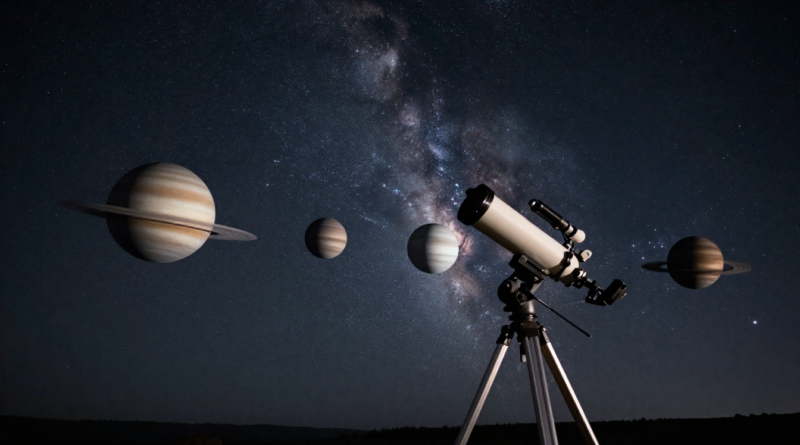
Planets Aligning Tonight: What It Means and How to See It
The phrase planets aligning tonight sparks excitement among skywatchers, astrologers, and anyone curious about the mysteries of the cosmos. Planetary alignments are among the most fascinating astronomical events visible from Earth. Whether you are a casual observer or a dedicated stargazer, understanding what this phenomenon truly means can enhance your appreciation of the night sky.
In this article, we’ll explore what planetary alignment really is, how often it happens, whether it has any scientific impact on Earth, and how you can observe it. We’ll also clear up common myths and answer frequently asked questions about planets aligning tonight.
What Does “Planets Aligning Tonight” Really Mean?
When people say planets are aligning tonight, they usually imagine all the planets forming a perfectly straight line in space. In reality, that is not exactly what happens.
All the major planets in our solar system orbit the Sun along a similar flat plane known as the ecliptic. Because of this shared orbital plane, planets often appear to line up in the sky from our perspective on Earth. This visual effect is what we refer to as a planetary alignment.
From Earth, planets like Mercury, Venus, Mars, Jupiter, and Saturn may appear close together along the same arc across the sky. However, in three-dimensional space, they remain separated by millions or even billions of miles.
How Often Do Planets Align?
Planetary alignments are not as rare as many believe. Small alignments involving two or three planets happen several times a year. Larger alignments involving four or five visible planets are less common but still occur periodically.
A full alignment of all eight planets in a near-straight line is extremely rare and may happen only once every many decades or even centuries. However, even during these events, the alignment is never perfectly straight due to the natural variations in orbital paths.
Astronomers track these alignments using advanced models and telescopes. Space agencies like NASA regularly publish information about upcoming celestial events so the public can prepare for viewing.
Which Planets Can You See Tonight?
If planets are aligning tonight, the ones most likely visible to the naked eye are:
Mercury
Venus
Mars
Jupiter
Saturn
Venus is often the brightest and easiest to spot. It is sometimes called the “Evening Star” or “Morning Star” because of its brilliant glow. Jupiter is also very bright and can be seen even in areas with moderate light pollution.
Mercury can be more challenging to see because it stays close to the horizon and is often washed out by twilight. Mars has a distinctive reddish tint, while Saturn may appear as a bright golden point of light.
For the best experience, find a location with minimal light pollution, such as a rural area or park away from city lights.
Best Time to Watch Planets Aligning Tonight
Timing is crucial when observing planetary alignments. Some alignments occur just after sunset, while others are best seen before sunrise.
Check local astronomical forecasts to determine the exact time for your region. In many cases, alignments are visible during twilight when the sky is dark enough to see planets but not completely black.
You do not necessarily need a telescope. Many alignments are visible to the naked eye. However, binoculars or a small telescope can enhance your view, especially for observing details like the rings of Saturn or the moons of Jupiter.
Do Planetary Alignments Affect Earth?
One of the most common myths about planets aligning tonight is that they cause dramatic effects on Earth, such as earthquakes, extreme weather, or gravitational disturbances.
Scientifically, planetary alignments have negligible impact on Earth. The gravitational influence of other planets on our planet is extremely small compared to that of the Moon and the Sun.
For example, the gravitational pull of Jupiter, despite being the largest planet in the solar system, is far weaker than that of our Moon when measured from Earth’s surface. There is no credible scientific evidence linking planetary alignments to natural disasters.
The Difference Between Conjunction and Alignment
It’s important to understand the difference between a conjunction and a full planetary alignment.
A conjunction occurs when two planets appear very close together in the sky. A famous example is the Great Conjunction of 2020, when Jupiter and Saturn appeared extremely close from Earth’s perspective.
An alignment, on the other hand, usually refers to multiple planets appearing along the same general path in the sky. Both events are visually stunning, but conjunctions are typically more dramatic because of the apparent closeness of two bright objects.
How to Photograph Planets Aligning Tonight
If you want to capture this celestial event, a few tips can help:
Use a tripod to stabilize your camera.
Choose a location with minimal light pollution.
Use manual settings to adjust exposure and focus.
Experiment with longer exposure times to capture faint planets.
Smartphone cameras can capture bright planets like Venus and Jupiter, but a DSLR or mirrorless camera with a zoom lens will provide better results.
Patience is key. The sky changes gradually, and sometimes the best images come after waiting for the perfect moment.
Why Planetary Alignments Fascinate Humanity
Throughout history, planetary alignments have held deep cultural and spiritual significance. Ancient civilizations closely monitored the movements of planets, often interpreting alignments as omens or divine messages.
Modern astronomy, however, explains these events through physics and orbital mechanics. The predictable movement of planets demonstrates the elegance and precision of our solar system.
Even without mystical interpretations, the simple act of watching multiple planets share the night sky can be awe-inspiring. It connects us to something far larger than ourselves.
How to Prepare for Tonight’s Planetary Alignment
Preparation enhances the experience. Here are a few practical steps:
Check weather forecasts to ensure clear skies.
Find a safe, dark viewing location.
Bring a star chart or astronomy app for guidance.
Arrive early to allow your eyes to adjust to darkness.
Give your eyes at least 20 to 30 minutes to adapt to the dark. Avoid looking at bright screens during this time.
If you are observing with children, take the opportunity to teach them about our solar system and inspire curiosity about science and space exploration.
Common Myths About Planets Aligning Tonight
There are several persistent myths surrounding planetary alignments:
The planets will form a perfectly straight line.
The alignment will cause massive natural disasters.
Gravity will temporarily weaken on Earth.
Electronics will malfunction.
None of these claims are supported by scientific evidence. Alignments are visually impressive but physically harmless.
Conclusion
The excitement around planets aligning tonight is completely understandable. Seeing multiple planets share the night sky is a rare and beautiful experience that reminds us of the dynamic nature of our solar system.
While planetary alignments may not cause dramatic physical effects on Earth, they provide an excellent opportunity to look up, learn more about astronomy, and reconnect with the wonders of the universe. Whether you observe with the naked eye or through a telescope, tonight’s sky offers a reminder that we are part of a vast and beautifully ordered cosmos.
FAQs
1. What time are the planets aligning tonight?
The exact time depends on your location and which planets are involved. Typically, alignments are visible shortly after sunset or before sunrise. Check a local astronomy forecast for precise timing.
2. Can I see the planets aligning tonight without a telescope?
Yes, most planetary alignments involving bright planets like Venus, Jupiter, and Mars can be seen with the naked eye. A telescope enhances the view but is not required.
3. Is planetary alignment rare?
Small alignments happen several times a year. Larger alignments involving multiple visible planets are less frequent but not extremely rare.
4. Do planetary alignments affect human behavior?
There is no scientific evidence that planetary alignments influence human behavior, emotions, or events on Earth.
5. How long will the planets stay aligned?
Alignments are usually visible for several days or even weeks, though the exact positioning changes slightly each night as the planets continue their orbits around the Sun.